No shared view
Heat, electricity, costs, and planning are often assessed separately.
Reduta Energy enables municipalities, consultants, distribution system operators, and heat utilities to model, compare, and explain energy scenarios. See in every stage which decisions can save millions, where grid capacity is constrained, where the most benefits are and why, and which projects should be prioritised.
Calculations are fully explainable and traceable. People and AI use the same recorded basis.
Build a local heating and cooling plan end to end with all available data.
Avoid costly wrong turns by simulating cost, grid impact, and risk in every stage of planning, implementation, and operations.
Compare heat, electrification, and decarbonisation scenarios in one place.
Let municipalities, consultants, grid operators, and heat utilities work together on the same data.
End users using our dynamic models can put their energy questions in plain language and get instant relevant and traceable answers.
The challenge
Data, studies, and assumptions often sit across separate systems and organisations. This makes scenarios difficult to compare and decisions hard to explain.
Heat, electricity, costs, and planning are often assessed separately.
Reports, assumptions, and model outputs lack one shared context.
Executives, residents, and partners need clear and traceable explanations.
Reduta Energy integrates documents, data sources, GIS‑layers, grid information, heat‑needs assessment outputs, consultancy reports, and assumptions (as is) into one coherent working model. Reduta provides a platform where real‑time data is combined with simulation and AI so processes and decisions become more predictable, auditable, and open to innovation. The platform runs in a private or public cloud and can connect to and form part of digital twins. The platform does not replace existing systems and reports. It connects them so AI, simulation, monitoring, and decision-making work within one operational layer.
Analyse a region or municipality, then zoom in to neighbourhoods, networks, projects, and individual homes. Compare scenarios at every level.
Studies · PDF studies · Excel models · GIS layers · Grid data · Heat-needs assessments · Consultancy reports · Assumptions · Open datasets
Buildings · Residents · Sources · Low-voltage grid · Heat networks · Cost · Assumptions · Stakeholders · Constraints
2026 · 2030 · 2035 · 2040 · Insulation · Heat pumps · Heat networks · Batteries · Grid reinforcement · Phasing · Macro effects · Energy prices
Cost · Grid loading · Constraints · Deliverability · Resident impact · Social effects
Scenario comparison · Local heating plan · Grid impact note · Executive justification · Resident briefing
Municipalities, consultants, grid operators, and heat utilities all work on the same energy transition, often with different data and priorities. Reduta brings that information together in one Digital Twin so choices can be justified faster and more thoroughly and aligned better.
Make proposals and decisions on heat, electrification, and infrastructure that can be explained to executives, councils, residents, local entrepreneurs, and regulators.
Reduta places reports, models, and assumptions in the wider energy system. Studies are not only delivered, but immediately usable in scenarios, maps, visualizations (e.g. grid load, heat networks), and executive trade-offs.
See how choices by municipalities, residents, and energy partners affect grid loading, capacity, investment, and phasing.
Three stages
Reduta uses the same model, data, and scenarios in every stage.
Calculate and compare business cases. Support proposed decisions, communication, and reporting.
Create feasible, shared plans. Coordinate delivery and adjust plans when conditions change.
Monitor the energy system. See when adjustments are needed and evaluate new solutions.
The AI agent works from the start on the same operational model as the calculations. Users and the agent work with the same recorded sources, assumptions, and calculation steps.
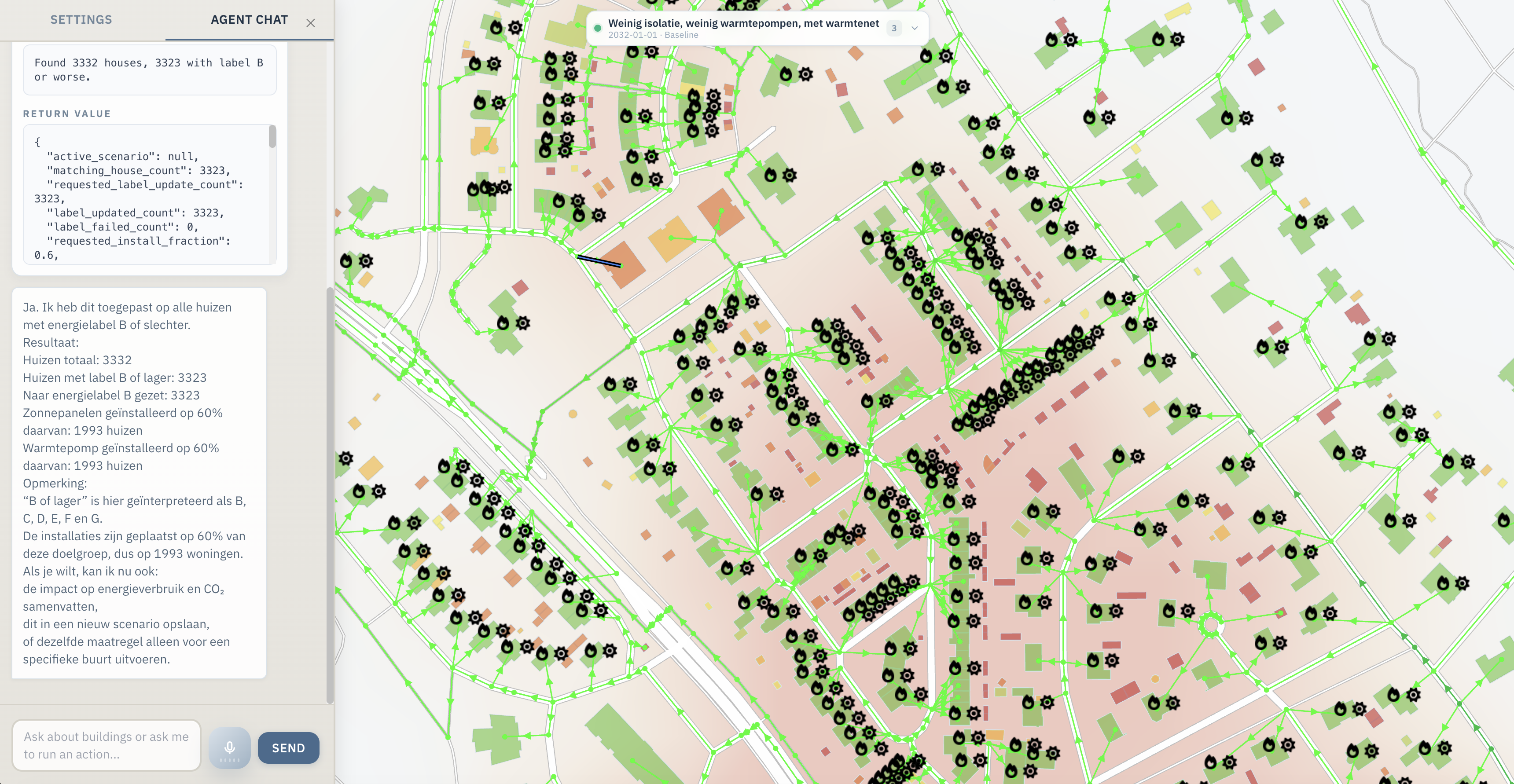
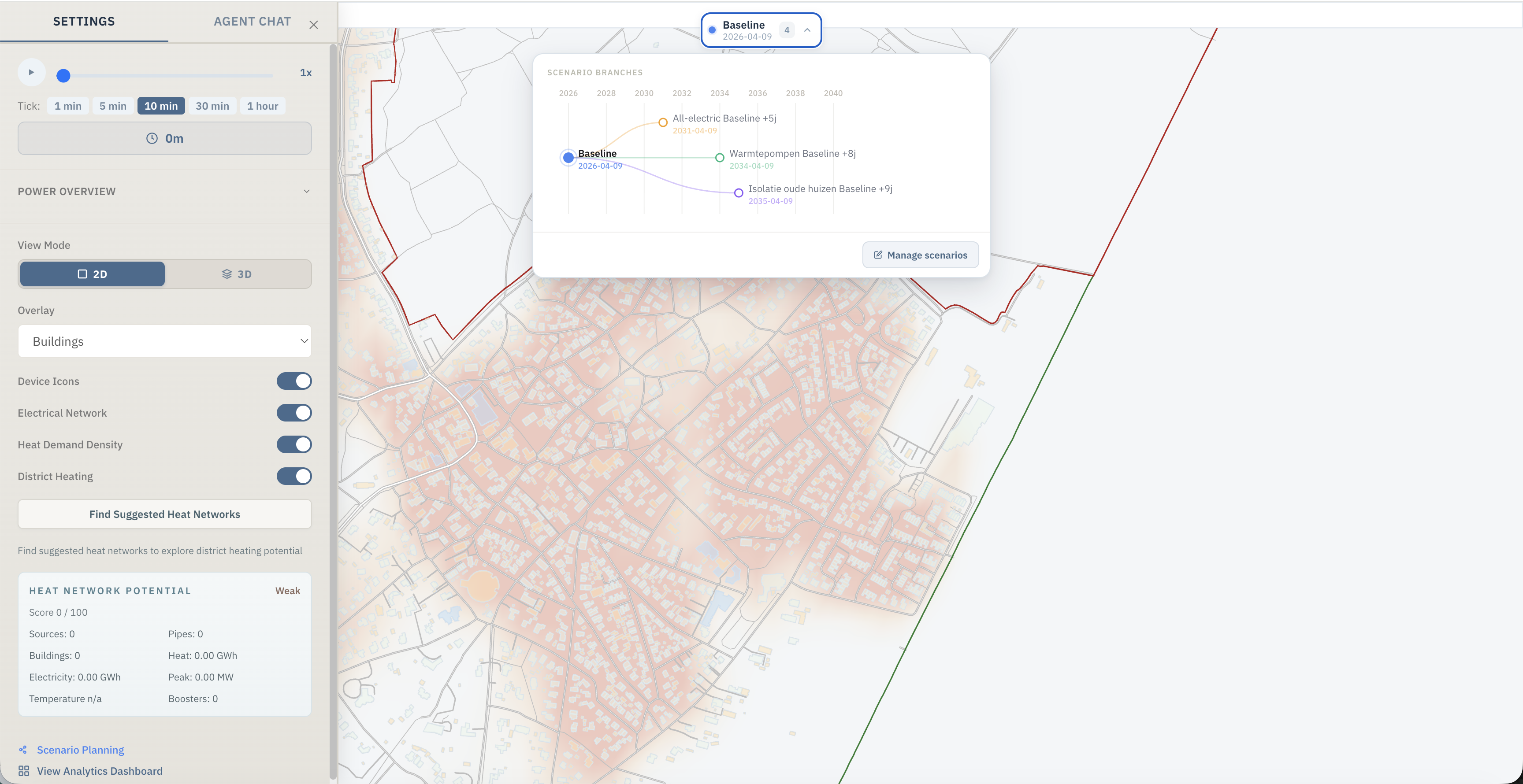
Internal teams and partner organisations work with the same data, assumptions, and scenarios. They can align plans and support interim decisions together.
Studies, grid information, GIS data, assumptions, and local knowledge land in one dynamic working model.
Parties discuss shared and agreed visions and approaches instead of assumptions based on static partial reports.
Executive choices, investment decisions, and resident communication rest on a traceable basis with the same starting points, enriched data, and methodology.
In development
Both extensions are coming soon and use the same data model, scenario engine, and AI agent.
Exchange heat network models through ESDL between Reduta and specialised WarmingUP tools.

Simulate future loads and translate required grid reinforcement into spatial delivery plans.
In the demo we show how a municipality uses Reduta Energy to build a local heating and cooling plan: from scattered (data) sources and assumptions to relevant scenarios, simulations, maps, cost comparison, and executive justification.
Reduta Solutions develops digital twins based on operational AI and simulation platforms for complex challenges and (critical) infrastructures. Our background spans energy systems, high-performance simulation, infrastructure, crowd modelling, healthcare operations, and defence.
Reduta Energy applies that experience to the energy transition: not as a standalone calculator, but as an operational platform for scenarios, collaboration, and explainable decisions.
In a demo we show how your data, studies, and scenarios can come together in one operational model.
We are happy to schedule a no-obligation meeting with you.
Questions? [email protected]

© 2026 Reduta Solutions